Understanding Democracy: Comparing SC Citizen and Legislator Perceptions of Democratic Health
By: Cade Hamm
Introduction
Democracy is a system of government in which the people hold power, either directly or through elected representatives, making societal decisions and interacting with their governance (Merriam-Webster, n.d.). Democracy was established to promote popular sovereignty, or simply put, the idea of majority rule, effectively preventing monarchs or other authoritative leaders from dictating over the desires of the people (Shapiro & Dahl 2025). The United Nations (UN) describes how their organization has grown to support democracy by their preservation of principles such as greater and equal participation, security, fundamental rights, freedoms, and the will of the people. As described by the UN, Democracy encourages open dialogue and disagreement free from persecution (2021). The Universal Declaration of Human Rights explicitly states that the will of the people shall be the law (United Nations, 1948). Democracy encourages participation, and promotes the protection of civil liberties. Not only this, but it prevents authoritarianism and ensures a government works for the people. .
If democracy is to be preserved as America evolves, it’s important to understand what the principles of democracy are and how they can be properly upheld. America was founded on a very tight moral system. This allows for the core principles of American democracy to be easily defined. These principles are the rule of law, federalism, a separation of powers, individual rights, popular sovereignty, and amendability (Geygan & Geygan Immigration Law Services, n.d). Shapiro and Dahl (n.d.) describe how these values act as a foundation for democratic systems, protecting the people from governmental overstep. These principles are common for most democratic nations across the world. In the US specifically, the separation of powers manifests itself in the branches of government– the executive, judicial, and legislative branches. These branches operate using checks and balances, preventing one branch from becoming too powerful. According to the Center for American Progress (2024), the mutual respect between branches of government ensures the continuation of healthy democracy.
The Carnegie Council for Ethics in International Affairs (2021) defines democratic backsliding as the declining importance of democratic values and principles inside of a government. This can cause institutional erosion and democratic failure. It is important to monitor democratic strength, as a failing democracy can threaten important civil liberties. This can be especially dangerous when legislators are not striving to protect these fundamental freedoms. This research raises questions about whether citizens and legislators perceive democracy’s health in the same way. This led to the research question: To what extent do South Carolina legislators believe democracy, as measured by Rights, Representation, the Rule of Law, and Fair/Equal participation, is declining, and how do these beliefs compare with citizen perceptions of democracy?

Literature Review
Citizen Perceptions of Democracy
In the past ten years, numerous polls have demonstrated that citizen perceptions of democracy have declined greatly. In one poll, by the Bright Line Watch (2025), the public showed a significantly declining opinion of American democracy. The survey explains how these results could be a consequence of how the “Trump administration has continued to challenge executive branch norms as well as legal and constitutional limits on the powers of the presidency” (p. 1). On top of this, a similar study done by The Pew Research Center (PRC) conducted research with similar results. Their findings showed that 72% of Americans used to think American democracy was a good example, but no longer is. Overall, relatively few Americans think American democracy is strong (PRC, 2025). These perceptions are not simply negative opinions, but a reflection of the anti-democratic trends harming the American government. According to the International Institute for Democracy and Electoral Assistance (International IDEA, 2023), the United States has experienced significant democratic backsliding since 2016. The decline in democracy was emphasized in equal representation, and rule of law. These findings, based on the framework of the IDEA’s Global State of Democracy (GSoD) democracy measurement indices, confirm that declining public perception is likely rooted in real backwards trends. It is also significant to note that there are major partisan differences. These party differences are expanded on and exlored in a study conducted by Flavin P. & Schufeldt G. Their research showed that party differences are longstanding. Their core finding was that the political party of a respondent was the most reliable indicator of their perception of democracy. This also showed that perceptions of democratic quality largely ignore objective measures. The study also found that even when factual data was presented to the respondents, opinions remained largely unchanged (2025). This can be explained by increasing political polarization. Polarization, or the ideological divide between parties, has “roiled” America in recent years (Kleinfield, 2023). In the same article, the author describes how political polarization can increase anti-democratic attitudes, and encourage political violence. This creates even more backsliding based disparities within citizens. Despite this, both parties still held a similarly negative view. These findings still suggest that citizen perceptions of democracy are reflective of backsliding. Scholars Castanho Silva and Wratil (2023) say that this kind of despondency could encourage more drastic political ideology, specifically populism, which can make democratic institutions even less stable than they already are. However, most existing studies focus on citizens, not policymakers, leaving open the question of how legislators themselves view the trajectory of American democracy.
Democratic Backsliding
Democratic backsliding is when a country, or a country’s leader, begins to erode at the fundamental liberties established in the given democracy. This can look like dismantling checks and balances, consolidating power, or decreasing trust in electoral credibility. The IDEA classifies a country as democratically backsliding when it falls more than a set threshold over five years in government checks or civil liberties. In 2020, seven democracies met that definition: Brazil, Hungary, India, the Philippines, Poland, Slovenia, and the United States. The United States has high overall democratic performance but experienced notable declines in congressional oversight of the executive and in freedom of assembly. This has worsened in recent years per updated IDEA data (IDEA, 2021). Democratic backsliding is closely linked with the topics previously discussed, falling citizen perceptions and elite-mass gaps. These faults make democracy appear more fragile, causing institutional failure and anti-democratic policy. The perceptions of legislators on the state of American democracy is very weakly researched, so it’s hard to understand the consequences of these potential divergence’s. The International IDEA’s Global State of Democracy Reports (2023) describe the measurable decline in the United States’ representation, participation, rights, and rule of law. These core pillars (representation, rule of law, fair and equal participation, and rights), are all used by the IDEA, and are vital to the institutional health of democracy. This conclusion makes it apparent that backsliding is occurring, and is likely due to foundational erosion and perceptual decline. If elites misunderstand the threats to democracy the constituency are observing, they risk exacerbating these issues. This highlights the importance of studying how policymakers evaluate democracy themselves. This is especially important considering the plethora of reliable organizations and reputable researchers all finding that American democracy is at risk (Bright Line Watch, Pew Research Center, IDEA). These findings connect to my previous research on falling citizen perceptions and elite-mass gaps. When the political elite misunderstand the health of democracy, it weakens the strength of representative democracy and prevents proper action from being taken. Despite extensive research on national decline and public opinion, there is almost no research assessing how legislators perceive democracy’s strength. There's a substantial amount of literature on things like elite–mass gaps examining voter misperception or party animosity (Broockman & Skovron, 2018; Druckman et al., 2023), but none evaluating legislators' conceptualization of the state of American democracy.
To address this gap, my project adopts a mixed-methods, survey-based approach rooted in the International IDEA’s Global State of Democracy (GSoD) framework. The GSoD is a large-scale project focused on assessing the strength of democracy in varying nations across the country. The GSoD breaks a country's democracy into different components, and then analyzes the efficacy of those components. To do so, they take into account a plethora of factors, including things like electoral credibility, access to justice, civil liberties, and they look at existing research on expert opinion to rank countries' democracies. One specific aspect of this research is their survey based data. The survey used is not originally the IDEA’s, but is adapted from V-Dem codebooks (Values of Democracy), a similar organizational method for democratic assessment, aiming to monitor world democratic health. The model the GSoD uses to survey experts divides democracy into four key pillars: Representation, Rights, Rule of Law, and Fair/Equal participation. These pillars are then broken into subthemes, which encourages further analysis. This framework allows researchers to closely study the perceptual health of democracy, identifying weak points, and allowing the collection of data to be replicable on a global scale. In my project, I will first study legislators, and then I will conduct a follow up survey on citizens. By comparing these perceptions, my research aims to identify whether policymakers’ views align with or diverge from the public’s, contributing new insight into how perceptual disconnection may influence democratic backsliding. By quantifying and contrasting these perceptions, the study can reveal whether legislators view democracy more optimistically, pessimistically, or accurately relative to citizens, and how these differences can impact policy.
Methods
Survey Design & Development
My project took a survey-based approach, inspired by the International IDEA’s GSoD, utilizing questions derived from the V-Dem codebook. The V-dem is a global research program led by the University of Gothenburg and the Kellogg Institute at the University of Notre Dame. The V-dem is a survey designed to collect and understand expert opinions on the state/health of democracy. The results were then broken into pillars, allowing for intensive data analysis. The pillars used in the V-dem study are Electoral Democracy Index (Representation), Liberal Democracy Index (Representation/Rule of Law) , Participatory Democracy Index (Fair/Equal Participation) , Deliberative Democracy Index, and Egalitarian Democracy Index (Fair/Equal Participation). For my research, these pillars were adapted to better fit modern American democracy and the general goals of my project. The adapted pillars I used are labeled in parentheses. The research I am conducting focuses on Representation, Rights, Rule of Law, and Fair and Equal participation. These pillars are simplified derivatives of the IDEA pillars, and questions for analysis were pulled from the correspondent IDEA pillar. To create these pillars for my research, I gathered four questions from each of the pillars that most effectively covered issues with American democracy. The questions I gathered and pillars I used focused on the most essential aspects of legislators' perception. The deliberative democracy index was fully excluded because it focuses on public debate, which falls outside the focus of my study. A survey based approach was selected because quantitative Likert data reveals broad patterns in democratic perceptions by pillar, promoting a deeper understanding of those patterns and their explanations.
Survey questions
After analysis of the V-Dem study, to shorten survey length for balance of construct coverage and respondent convenience, the four most pertinent questions were extracted for each pillar. Each of these 16 questions can be answered with a likert scale adapted to fit the questions. The likert scale can be answered in: 1= Not at all/Very poorly, 2= Slightly, 3= Moderately, 4= Mostly/Well, 5= Fully/extremely. This mirrors the structure of the V-dem survey with slight adaptations to better fit quick legislator response. Due to the consistency of scale anchors across all items, consistently higher values indicate stronger democratic performance. Additionally, at the beginning of both surveys, two demographic questions were asked about age and political party. By taking questions from existing, reputable surveys (V-dem and the GSoD), it ensured the reliability of my questioning. Implementing the likert scale for all pillars and questions further solidified this validity.
Data Collection
The survey was distributed to members of the South Carolina General Assembly through email. Responses were voluntary and kept anonymous to protect the safety of the legislators. Legislators were informed their responses were for an academic based research project. All legislators with publicly accessible emails on the South Carolina House website were emailed a link and explanation of my project. Due to a lack of responsiveness, the legislator survey was also distributed to personal connections, who were then asked to share it with other legislators they could contact. Then, after those responses were collected, another round of emails were sent to the publicly accessible legislator emails available on the South Carolina Legislature website. Social media was used to collect citizen responses. The survey was initially published to the researcher’s facebook account, where it was then reposted by connections, and was left open until data was needed for results.
Data Analysis
To analyze the data, responses were first grouped into the four pillars; Representation, Rights, Rule of Law, and Fair and Equal participation. These responses could then be coded into one of 16 sub themes, such as Free and Fair elections, or Government responsiveness. Since a Likert scale was used, scores were averaged for each pillar, allowing analysis of pillars by legislators. For each pillar, the mean score was titled “Democracy Perception Indices”. This was structurally similar to the data analysis used by the GSoD and V-Dem. These responses were also looked at based on political party and age, to observe partisan or generational differences in terms of democratic perception. Statistical significance was analyzed through a Mann-U Whitney Test and correlational analysis. Means and medians were compared to identify weak points and graphs were used to visualize overall trends. The p-values were also utilized to compare level of difference and its significance.
To compare differences between these responses, a Mann Whitney-U test was used. A Mann Whitney-U test is nonparametric, and compares ranks between two independent samples. It allows for the exploration of the differences between medians and overall distribution through the use of ranks. Ranks are essentially general trends. In a one-tailed Mann Whitney test, the trends are analyzed directionally based on the hypothesis. In my project, this was used because both of my hypotheses predicted that one group would be larger (Legislators would see democracy stronger than citizens and Republicans would see democracy as stronger than democrats). Since the data collected in this research is coded on a numerical likert scale, it does not meet the assumptions required for parametric tests such as the independent-samples t-test. This is because skewed responses across varying indicators mean the data is not normally distributed. Not only this, but the small sample size of the legislator response group would interfere with the accuracy of a parametric test.
When surveying elite populations, specifically in political science, the population threshold is inherently small. This leads to significant boundaries when attempting to collect a reasonable sample. However, due to the elitist and hard to reach nature of these individuals, for accuracy, a large sample size is not always necessary (Lopez, 2022). On top of this, much of the research on elite surveys notes that the political elite have reasons for the lack of responsiveness, such as intense schedules, and high demand. This creates the need to balance constraints with attainable sample size and the truly available population (Vis & Stolwijk, 2020). When researching, this small sample size was expected, and compensated for with analysis, outreach methods, and recognition of practicality given the scale of my research. My focus prioritized regional diversity over a large sample.
Ethical Considerations
The responses were kept anonymous for legislator safety, and participants were informed of their right to quit at any given time. No identifying data was collected. My study was in alignment with standard research related ethical guidelines for human subjects.
Results
This section reports the statistical data collected by my citizen survey and legislator survey. The goal of this analysis was to compare citizen and legislator perceptions of democracy, and where perceptual health is the greatest/weakest. This study also aimed to analyze how strong legislators perceived democracy by pillar, how strongly citizens perceived democracy by pillar, and how partisan differences impact response.
After my survey was published, I received 15 legislator responses, and 202 citizen responses. Based on standard sample size calculations for estimating population-level proportions at a 95% confidence level with a 5% margin of error, approximately 385 citizen responses would be required to generalize findings to the population of South Carolina residents aged 17 and older. The present study obtained 203 citizen responses, which allows for comparative and inferential analysis but limits the precision of statewide generalization. The sample size of 203 gave an estimated margin of error of 7%, reducing precision but still allowing for comparison of perceptual tendencies and distributional trends. This allowed me to compare perceptual health by indicator.
The true legislator population for this study was the 170 members of the South Carolina General Assembly. The collected legislator sample size was 15 respondents, giving an estimated margin of error at the 95% confidence level of 24%. This large margin of error reflects the small sample size and the elite, hard-to-access nature of the population. The legislator results do not serve as population estimates, but rather as suggestive measures of institutional perceptions among elected officials. Despite limited generalizability within the legislator population, the sample remains appropriate for comparative nonparametric analysis examining perceptual differences between legislators and citizens response groups.
The study utilized non-probability sampling as respondents were gathered through email outreach and social media posts. Unlike random, or probability sampling, it is not guaranteed that the sample is representative of the population This means that traditional margin of error calculations are not strictly valid. It’s important that findings are considered as indicative of trends rather than precise population estimates.
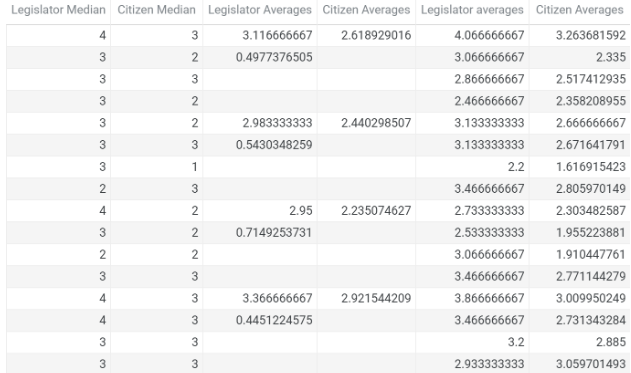
Across the majority of democratic health indicators, citizens and legislators demonstrated statistically significant differences in perception. Legislators consistently reported higher confidence in democratic institutions than citizens. Citizens reported greater skepticism and lower perceived democratic performance, particularly on items related to accountability, representation, and institutional trust.
Across every single question, the legislator response medians and means were higher.
The difference in means between legislators and citizens was most significant for the Rule of Law Pillar. This is important because question 10, the accountability of government officials, had an incredibly large difference between means, with legislators rating it on average, 1.16 points higher.
It’s also important to note that the majority of citizen indicators had averages of below 3 (13/16), meaning that the consensus among the population surveyed was that democracy was in practice, negative. Additionally, when considering the pillars as a whole, found by averaging all of the indicators for a given pillar, rights, representation, rule of law, and fair and equal participation, averages were all below 3, indicating disagreement. This is inconsistent with legislator responses as the majority of their democratic indicators (9/16) averaged at above 3, with ¾ of their pillars also receiving this treatment.
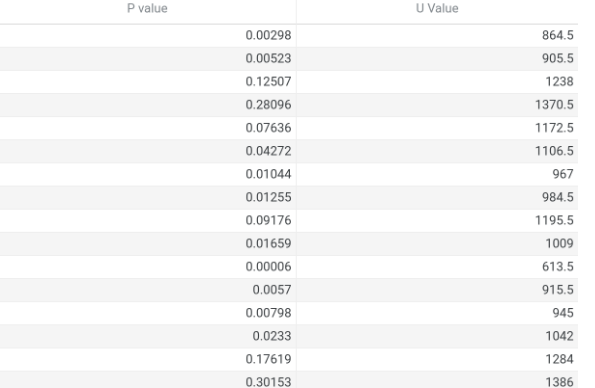
To evaluate whether these differences were statistically significant, a series of one‑tailed Mann–Whitney U tests were conducted comparing legislator responses (Group 1) to citizen responses (Group 2). Between legislators and citizens, ten of the sixteen questions produced statistically significant results at the α = 0.05 level, indicating that legislators’ higher evaluations were not due to random variation. The largest differences occurred in assessments of equal application of the rule of law, accountability of government officials, protection of civil and human rights, and minority representation in policymaking. These areas are components of the Rule of Law and Rights pillars, suggesting that legislators perceive institutional fairness and accountability more favorably than the public does.
In contrast, a smaller number of indicators did not show statistically significant differences between the two groups. These exceptions imply that while the elite–mass gap is broad, it is not uniform across all dimensions of democratic performance.
A second set of one tailed Mann–Whitney U tests examined partisan differences within the citizen sample. Republicans consistently rated democratic institutions more positively than Democrats, with statistically significant differences on 13 of the 16 indicators. The largest partisan gaps emerged in evaluations of minority representation, gender equality in political influence, political participation, and equal application of laws. These findings align with national research showing that democratic satisfaction often tracks partisan alignment rather than institutional design. Notably, no significant partisan differences were found for media independence or electoral fairness, suggesting that these domains may be perceived as equally problematic.
Taken together, the results indicate two distinct perception gaps. First, an elite–mass gap, in which legislators view democratic institutions as functioning more effectively than citizens do. Second, a partisan gap, in which Republicans express higher confidence in democratic performance than Democrats. Both gaps appear systematic rather than incidental, as demonstrated by the consistency of the direction of differences and the statistical significance across multiple indicators.
Discussion
This study set out to examine whether perceptions of democratic decline differ between South Carolina citizens and legislators, and these findings suggest that democratic health is experienced differently depending on one’s institutional role and political identity. Legislators’ more favorable evaluations may reflect greater procedural knowledge, closer proximity to institutions, or differing interpretations of the survey items. Citizens, by contrast, may evaluate democracy through lived experience, partisan cues, or perceptions of fairness and inclusion. The partisan divide further indicates that trust in democratic institutions is not evenly distributed across the electorate, which may have implications for political engagement, institutional legitimacy, and public support for democratic reforms. Across all four democratic pillars legislators evaluated democratic performance more positively than citizens, suggesting the existence of a systematic elite-mass perception gap whether than one off disagreement. This gap is consistent with research in the field all demonstrating that elite misperception encourages policymakers to analyze/create policy based on their own feelings rather than the constituent consensus. It’s possible that legislators’ more favorable assessments are a result of their more active political involvement and proximity to democratic institutions, as persistent exposure can make structural weaknesses look normal. Citizens are more likely to evaluate democracy based on their personal experience and their own perception of systematic fairness.
The most prominent divide occurred in the Rule of Law Pillar, specifically with government accountability. This demonstrates that government agents significantly differ in their opinion of institutional oversight. This finding can be dangerous, as rule of law is essential to accountability and democratic legitimacy.
These findings, as aforementioned, also showed a strong partisan divide. Republicans consistently rated democracy higher than their democratic counterparts. This indicates that democratic perceptions are likely shaped by partisan identity. It’s important to note that the current administration is republican, the judiciary is republican, and Congress is also republican. These heightened perceptions of democratic performance could be influenced by partisan alignment.
Several limitations need to be acknowledged. First, the legislator sample size was incredibly small relative to the total population of the South Carolina general assembly population. Although elite survey research recognizes the practical constraints of a large legislator sample size, this still creates a large margin of error limiting the generalizability of these findings. This means the results are not definitive population estimates but are merely indicative of trends in opinions of the political elite.
Second, the citizen sample, while effective for analysis, did not meet the requirements for precise statewide generalization. The sample size was 203, giving a margin of error of about 7%. Additionally, my method of distribution through social media can create selection bias. This is because people who go out of their way to respond to a political survey are likely more politically engaged than the ordinary citizen. This is also known as voluntary response bias.
Furthermore, this study lacks objective analysis of democratic quality. The research focuses on perceptual gaps and performance. Perception is important, but the findings don’t empirically reflect the state of democracy.
Finally, the response data only takes democratic performance at a snapshot in time. Democratic evaluations are highly volatile, as political controversy significantly influences citizen perceptions of democratic health. If research was conducted over a period of time, it could show how perception gaps evolve over time.
Despite these limitations, the study still provides meaningful comparative evidence of elite-mass perception gaps and how citizen and legislator opinions diverge. This contributes to academic literature about democracy and its implications.
Conclusion
The findings reveal a consistent and statistically significant elite-mass perception gap. Legislators rated democratic performance higher across all indicators and core democratic pillars. On top of this, there was a clear partisan divide where Republicans also rated democracy higher than democrats.
These results suggest that perceptual health is shaped by institutional role and partisan identity. Legislator’s proximity to democratic processes increases their trust in performance. Citizens may assess democracy through lived experiences, institutional fairness, and government satisfaction/partisan alignment.
This research contributes to new insight on how and where democracy is backsliding at a subnational level. While national studies frequently assess citizen satisfaction, this research gives understanding into how policymakers disagree or agree with their constituents and how citizens view democracy at a state level. The findings suggest that preserving democratic legitimacy requires attention to institutional awareness, reform, and alignment.
Bibliography
Bright Line Watch. (2025, April). Wave 25 public and expert survey report: Threats to democracy and academic freedom after Trump’s second first 100 days. Retrieved from https://brightlinewatch.org/
Broockman, D. E., & Skovron, C. (2018). Bias in perceptions of public opinion among political elites [PDF]. American Political Science Review, 112(3), 542–563. Retrieved from https://calgara.github.io/Pol157_Spring2019/Broockman%20%26%20Skovron%202018.pdf
Carnegie Council. (2021). Democratic backsliding. https://carnegiecouncil.org/explore-engage/key-terms/democratic-backsliding
Castanho Silva, B., & Wratil, C. (2023). Do parties’ representation failures affect populist attitudes? Evidence from a multinational survey experiment. Political Science Research and Methods, 11(2), 347–362. https://doi.org/10.1017/psrm.2021.63
Center for American Progress. (2024, September 26). An American democracy built for the people: Why democracy matters and how to make it work for the 21st century. https://www.americanprogress.org/article/an-american-democracy-built-for-the-people-why-democracy-matters-and-how-to-make-it-work-for-the-21st-century/
Coppedge, M., Gerring, J., Knutsen, C. H., Lindberg, S. I., Teorell, J., et al. (2023). Varieties of Democracy (V-Dem) Codebook v14. University of Gothenburg. https://v-dem.net/documents/55/codebook.pdf
Druckman, J. N., Broockman, D. E., Kalla, J. L., & Porter, E. (2023). Correcting misperceptions of out-partisans decreases American legislators’ support for undemocratic practices. Proceedings of the National Academy of Sciences, 120(16), e2301836120. https://doi.org/10.1073/pnas.2301836120
Explainer: Democratic backsliding. (2021). Idea.int. https://www.idea.int/blog/explainer-democratic-backsliding
Flavin, P., & Schufeldt, G. (2025). Citizen’s perception of the quality of democracy in the American states. Social Science Quarterly. Advance online publication. https://doi.org/10.1111/ssqu.13359
Geygan and Geygan Immigration Law Services. “A. Principles of American Democracy.” Geygan & Geygan Immigration Law, https://geygan.net/geygan-geygan-immigration-law-services/naturalization/naturalization-test/a/. Accessed 25 Nov. 2025.
Harrison, R. (2025). Understanding Democratic Backsliding: Insights from Leading Researchers | Institution for Social and Policy Studies. Yale.edu. https://isps.yale.edu/news/blog/2025/03/understanding-democratic-backsliding-insights-from-leading-researchers
International IDEA. (2023). The Global State of Democracy Indices Methodology: Conceptualization and Measurement Framework (Version 7). https://www.idea.int/sites/default/files/GSOD/global-state-of-democracy-indices-methodology-v7-2023.pdf
Kleinfeld, R. (2023, September 5). Polarization, democracy, and political violence in the United States: What the research says. Carnegie Endowment for International Peace. https://carnegieendowment.org/research/2023/09/polarization-democracy-and-political-violence-in-the-united-states-what-the-research-says?lang=en
Merriam-Webster. (n.d.). Democracy. In Merriam-Webster.com dictionary. Retrieved October 6, 2025, from https://www.merriam-webster.com/dictionary/democracy
Shapiro, I., & Dahl, R. A. (n.d.). Democracy. In Encyclopaedia Britannica. Retrieved July 10, 2025, from https://www.britannica.com/topic/democracy
United Nations. (1948). Universal Declaration of Human Rights. https://www.un.org/en/about-us/universal-declaration-of-human-rights
United Nations. (1966). International Covenant on Civil and Political Rights. OHCHR; United Nations. https://www.ohchr.org/en/instruments-mechanisms/instruments/international-covenant-civil-and-political-rights
United Nations. (2021). Democracy. United Nations. https://www.un.org/en/global-issues/democracy
Walgrave, S., Soroka, S., Loewen, P., Sheafer, T., & Soontjens, K. (2022). Revisiting elite perceptions as mediator of elite responsiveness to public opinion. Political Studies. https://doi.org/10.1177/00323217221105170
Wike, R., Fetterolf, J., & Schulman, J. (2025, June 30). Dissatisfaction with democracy remains widespread in many nations. Pew Research Center. https://www.pewresearch.org/short-reads/2025/06/30/dissatisfaction-with-democracy-remains-widespread-in-many-nations/
Elite Perceptions of Democracy
The term elite perception, as used in political research, refers to how the political elite view the opinions of their constituency. This becomes vital for democratic health because the accuracy of elite views on citizen perceptions of democracy significantly impacts their ability to make reflective and effective policy. According to Walgrave et al. (2022), the opinions of elites about how citizens feel often affect the link between public opinion and government action. This means that democratic outcomes can show what elites think instead of what the public actually thinks. Many experts describe this separation as an elite–mass gap, where policymakers’ beliefs about the constituency greatly differ from actual opinions. This gap undermines representative democracy and can erode institutional legitimacy. This connects to the previous claim, as a plethora of research shows that the political elite of America don’t fully understand the views of American voters. In a study done by Broockman, D. E., & Skovron, C., the researchers found that legislators systematically misunderstand voter opinion. On essentially all controversial issues they were surveyed on, they inaccurately assessed the views of their constituents, drastically overestimating conservatism in their districts. However, this issue can be overcome. James Druckman and colleagues conducted research concluding that when legislators are informed of true citizen opinions, their behavior can be adapted. In their study, the researchers interviewed legislators on their views of the opposing parties democratic values. Then, they surveyed citizens from the opposing party to compare these perceptions on both sides. The legislators greatly overestimated the opposing parties animosity, and their readiness to act undemocratically. Despite this, when informed of the opposing party's true views on democracy, the legislators adjusted, and their own value for democratic processes increased. This demonstrates that understanding constituent views, and democratic trends, can have a positive impact on American policymaking. There is very limited research on surveying legislators on the democratic health of America, as the bulk of research solely focuses on elite-mass gaps. The closest project, the study by Druckman et. al, only discusses the anti-democratic action legislators perceive from their opposing parties. This reflects a need for more research on whether or not American policymakers understand empirical data and citizen views on backsliding democracy so proper action can be taken.