The necessity of civic engagement
The idea of democratic collapse usually evokes images of racial takeovers, coups, revolutions, or just sudden breakdown. However, democratic erosion is slow, gradual, and usually not noticeable by those not looking. These things are visible and easy to ignore. The biggest threat to democracy is not a political crisis, but public ignorance.
Democracy is centered around participation and public engagement. Citizens must vote, stay informed, and question their leadership. When participation declines, so does systematic strength. Foundations can slip and the pillars of democratic health can slowly fail.
Disengagement is increasing. Citizens are growing increasingly frustrated, and participation is waning. Political systems are untrustworthy and are not given necessary attention. Civic involvement diminishing can impact voter turnout, limited media engagement, and overall withdrawal from politics. This disengagement creates a dangerous gap.
When fewer people are involved, political influence becomes concentrated among smaller factions. This leads to dangerous control and can also create even more dangerous polarization between these smaller, more exclusive groups. When smaller groups of people hold a larger body of power, representation becomes weaker, furthering public dissatisfaction. Declining trust leads to declining engagement, threatening the stability of our democracy.
Strengthening democracy is not just about protecting against radicalism, it is about encouraging moderation, paying attention, and questioning the institutions and how they are being upheld. For democracy to function properly, the people need to have a relationship with the government, and should actively strive to understand what is going on and why. If that connection is destroyed, it is not easy to rebuild. Individuals must recognize their responsibility, and larger efforts for civic education should be implemented.
Democracy is resilient, and this is mostly true. But this resilience depends on the people. Without an attentive population even the most stable system can fall. Democracy doesn’t fail because it is overthrown, it fails because it is neglected.
Broken Promises and Democratic Function
Presidential campaigns are built on the backs of promises. Each candidate describes their goals
for their presidency, and what they will strive to achieve. Some goals are not meant to be fully completed, but a large portion of these promises are reasonable to accomplish. When the government makes false promises it undermines democratic legitimacy and prevents the people from voting for meaningful change.
Donald J. Trump made a plethora of promises during his lengthy campaign, and a large portion of these have not been completed.
Promise #1: He would create new jobs
Job creation has greatly slowed since Trump took office. In 2025, the United States only added 184,000 jobs, the lowest year since the pandemic, significantly falling under the predicted growth of $584,000 (Groundwork Collaborative, 2025). According to a 2026 report by CNN, in February the economy lost around 100,000 jobs, and unemployment held out at 4.4%. In data compiled by the Bureau of Labor Statistics, it is clearly evident that job loss was the norm in the first years of Trump’s presidency
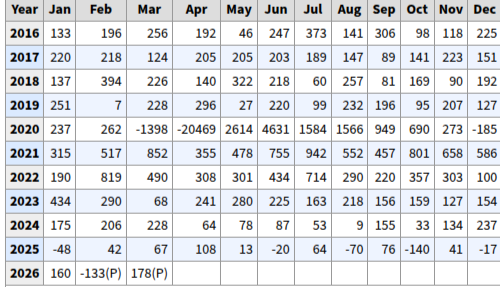
However, as also evidenced by this table, we can see that job growth in march greatly increased, straying away from the previously negative trends. 178,000 jobs added, comparatively, is not impressive, but merely hopeful. Even with the growth in March, in the larger scheme of Trump’s presidency this point serves as an outlier.
Promise #2: Inflation will decrease
The Trump administration promised that inflation would decrease, say one, but despite this, economists have noted rises in inflation, and expect this trend to continue for the duration of Trump’s term. Research by the Center for American Progress describes how inflation has steadily remained above the federal goal of 2 percent, and the authors cited two studies attributing this elongated increase to the actions of the current administration. In a research article published by the American Federation of Teachers, addressing how Trump has broken promises to the working class, the authors discuss how “Inflation has surged to 3 percent” (AFT, n.d).
Promise #3: Consumer prices will go down
In the same paper by the Center for American Progress, the evidence clearly shows that tariffs are responsible for a drastic increase in consumer spending and grocery prices. To be exact, the researchers estimate that Americans are paying $17,500 more to build a new home, small business owners are paying $25,000 more to import goods, and the average household is paying about $17,000 more (2026). A similar study published in the New York Times reaffirms this claim, describing how grocery prices have risen at the fastest rate since 2022 due to importing tariffs implemented by the Trump admin (Draper & Cresswell, 2025).
Promise #4: No new wars
One of the most vital aspects to Donald Trump’s campaign was his promise of “No New Wars”. He has been repeating that phrase over the past decade.
(Writing cannot emphasize enough how constantly this idea was repeated by the President so a video is attached below)
https://www.youtube.com/watch?v=5BumE9rI6js
Despite these promises of international cooperation and diplomacy the President has ruthlessly engaged in conflicts across the globe. First, the President invaded Venezuela, capturing the leader, and bringing him to the United States. Then, the President cooperated with Israel to invade, bomb, and engage in conflict with Iran. In both instances American feet stepped on the soil of different countries to fight foreign agents. In both instances, the peace was not held. Similarly, existing conflicts were not resolved.
Promise #5: An end to the war in Russia and Ukraine
The War in Russia and Ukraine is ongoing. Regardless of promises that the war would end on Day 1, lives are still being lost in mass. In fact, a new report by the United Nations (UN) found that 2025 was the deadliest year for Ukraine since 2025, with over 2,000 Ukrainians being murdered (UN Human Rights, 2026).
Promise #6: Lower Gas Prices
After entry into a war with Iran, gas prices have slowly climbed over the past month. Now, gas prices across the country are nearing a staggering $4 per gallon. IVTB news published a headline detailing these shocking prices, citing data from the AAA that found the national average was more than $4 a gallon. Out of all states, data found that the lowest average was $3.28, still marking a large increase from the previous averages that hovered around $2. Trump’s action in Iran has measurable and predictable outcomes. Economists globally are well aware of the strategic advantage the Strait of Hormuz has. These decisions are made consciously by the President, and passed through a team of advisors, economists, and military experts, all who would report the consequences of military action. Yet the decision was still made and violence still continues in the region.
Promise #7: Capping credit card interest rates
Another campaign promsie of Trump was capping credit card interest rates at 10%. The action taken has been questionable and challenged by many democratic lawmakers. Senator Elizabeth Warren has gone into lengthy detail about this, so for clarity, here are excerpts from her piece on the president's failure (op-ed dated Febrauary 23)
Initially, Trump did propose action. In fact, “On January 9, the President seemed poised to act. He announced that credit card companies will no longer rip off the American people – and then he politely asked the biggest banks to put in place a one-year, 10% cap on credit card interest rates by January 20.”
However, she also details how this polite request for the credit card companies to change was an interesting measure to challenge the credit debt crises. To no one's surprise, “That was six weeks ago. President Trump’s January 20 deadline has come and gone, and no one is surprised that the big banks have not voluntarily cut credit card rates to help American families” As of today, April 4, 2026, this credit card interest cap has still not been put in place.
Warren also described how the people and the legislature is ready. She says that “Americans want relief – and Democrats are ready. After the President called me, I reached out repeatedly to his Chief of Staff Susie Wiles to share ideas about how to design an emergency 10% rate cap that prohibits banks from retaliating by shutting down accounts, reducing credit lines, or devaluing rewards. I also explained how we could transition to a permanent rate cap, so credit card companies can’t go right back to ripping people off after one year.” (Warren, 2026).
This once again reflects a massive failure of the President to implement meaningful action promised in his campaign. Requests and polite asks don’t make change. Legislation and action does.
Promise #8: Protection of Social Security
Trump also made numerous promises about Social Security prior to his election, the most significant of which being his promise to end the taxation of Social Security, and a guarantee to protect it. Trump claimed to pass laws contributing to the end of Social Security taxation, but his Big Beautfiul Bill and his Flagship tax and Spending Law did “nothing of the sort” (Williams, 2025). Despite the benefits of his new program, and possible tax deductions offered by these changes, the point of the matter is that his word was not kept. According to an article published by the Democrats, addressing the broken promises of the president, they describe how “Trump’s own Treasury Secretary Scott Bessent admitted that Trump’s “One, Big, Beautiful Bill” is a “backdoor for privatizing Social Security,” after Trump stacked the Social Security Administration with incompetent leadership, and Shadow President Elon Musk gutted the agency” (2025).
Promise #9: Reduction of the national debt
A yahoo finance headline clearly describes one of Trump's key promises and consequences:
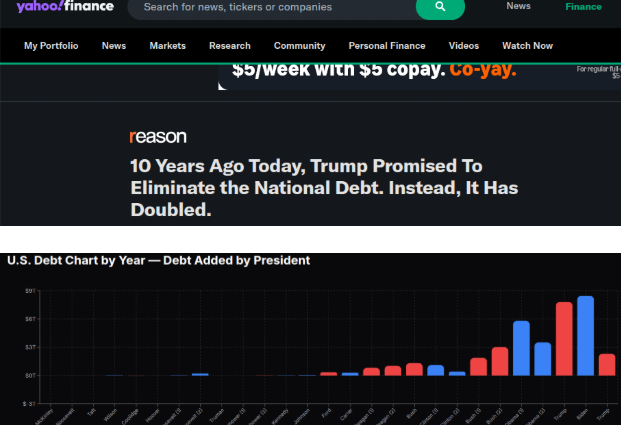
The Committee for a Responsible Budget agrees with this figure, estimating that in the next ten years Trump’s policy and executive action will result in an added $8.4 trillion dollars to the national debt.
The current president with the most highest debt added is Joe Biden, with a similar $8.4 trillion added. However, when we look at both of Trump’s terms, he currently sits at the most debt added, and as the debt keeps expanding, he could well surpass the most debt added by a President in a single term. Once again, his commitment to public demand and commitment to the subsequent conduct necessary to achieve these goals are both lackluster.
Promise #10: The Epstein FIles
Arguably the biggest controversy in American history, Trump’s involvement with the Epstein files, and his involvement with the release of new information surrounding the files has stunned the global community. Trump committed himself to public disclosure of this incredibly vital information, but failed to follow through after being elected. The Epstein files are an increrdibly long record of relationships between Epstein and thousands of elire people from a variety of fields. The calls for the release of these files have been ongoing since his arrest and would give the public insight into the true nature of Epsteins pedophilia ring. Trump and his allis promised on numerous occassions that he would release the files and would be fully transparent with the information in them. Despite this, after information about Trump in these files was released, tehre was mass delays, conflicting statements, and narratives developing that were constantly evolving.
During Trump’s first presidency there was no initiative to release the files and there was actually no large scale declassifcation of files beyond standard court procedures. The executive branch has direct influence over the Department of Justice and effort towards transparency would have absolutely been in the President's reach.
After the death of Epstein in 2019 Trump publicly supported conspiracy theories that the death of Esptein could’ve involved political opponents. He failed to analyze existing evidence, used the death as a political weapon, and shifted the narrative towards speculation.
Under Trump’s Department of justice, the attorney general, William Barr, released very limited information about Epstein’s death, did not release any broader cleint list, and reflected the Trump adminstrations failure to disclose relevant information when it really mattered
Trump has frequently stated he wants to clear the deep state, or, “drain the swamp” as he says. Once again, there was no major effort to declassify or expose major networks related to Esptein. This not only shows his failure to keep Epstein related promises, but demonstrates a broader trend of inconsistency.
In 2025, Trump’s administration ordered a review of the Epstein Files. Upon review, the Department of Justice stated there was no client list, and no further exposures would be made. Again, the Trump administration across terms consistently failed to be transparent.
Trump’s resistance to release continued to grow into late 2025, and public outrage grew to a point of no return. Deadlines were met and passed, hearings were held, and much of congress intensely questioned political figures like Kash Patel and Pam Bondi on the release of the files. Eventually though, the files were released
Regardless of release, the files were heavily redacted, and information continued to be withheld. Many releases provided no new information, and pages upon pages were blacked out entirely. Full public transparency has still not been met.
Bibliography
AFT. (n.d.). Trump’s broken promises are working against working people. American Federation of Teachers. https://www.aft.org/trumps-broken-promises-working-people
American Progress. (n.d.). A year in review: How the Trump administration’s economic policies made life less affordable for Americans. https://www.americanprogress.org/article/a-year-in-review-how-the-trump-administrations-economic-policies-made-life-less-affordable-for-americans/
Bureau of Labor Statistics. (n.d.). All employees, total nonfarm [CES0000000001]. U.S. Department of Labor. https://data.bls.gov/timeseries/CES0000000001?output_view=net_1mth
CNN. (2026, April 2). US jobs report March preview. https://www.cnn.com/2026/04/02/economy/us-jobs-report-march-preview
Democrats.org. (n.d.). 200 days of Trump: Promises made, promises broken. https://democrats.org/news/200-days-of-trump-promises-made-promises-broken/
Finance Yahoo. (n.d.). 10 years ago today: Trump administration economic impact. https://finance.yahoo.com/economy/policy/articles/10-years-ago-today-trump-163011386.html?guccounter=1&guce_referrer=aHR0cHM6Ly93d3cuZ29vZ2xlLmNvbS8&guce_referrer_sig=AQAAAIty2D5rpz0i5R8p1YKGY1Xu087m7r7oCcTHeYWoeKMKlaQ47XrI5itfmt8ONIPDxUst4aEz2kfCYKOhWhswHz3Tivj2hh0hopQYYVymaeqc3-fW-hv5JXQpG5rnENLZB5HhXkn9tLtgl7Jxfs6Q6HJ-gZStYMrRjuWmBhW5OwCV
Fox News. (n.d.). Sen. Elizabeth Warren on President Trump’s broken promise: Credit cards. https://www.foxnews.com/opinion/sen-elizabeth-warren-president-trumps-broken-promise-credit-cards
Groundwork Collaborative. (n.d.). Revised data paints a grim picture of 2025 jobs market. https://groundworkcollaborative.org/news/revised-data-paints-a-grim-picture-of-2025-jobs-market/#:~:text=Annual%20revisions%20show%20the%20economy,Job%20gains%20remain%20narrowly%20concentrated.
KTTV/KTVB. (n.d.). Gas prices rise nationwide for gasoline and diesel. https://www.ktvb.com/article/news/nation-world/gas-prices-national-average-gallon-diesel-rise/507-ed8d5621-5d42-4572-9069-6a81fb00ece1
MarketWatch. (n.d.). The U.S. isn’t creating many jobs anymore; the March jobs report won’t buck the trend. https://www.marketwatch.com/story/the-u-s-isnt-creating-many-jobs-anymore-the-march-jobs-report-wont-buck-the-trend-4db266c8
New York Times. (2026, January 14). Food prices rise under Trump tariffs. https://www.nytimes.com/2026/01/14/business/food-prices-tariffs-trump.html
CRFB. (n.d.). How much did President Trump add to the debt? Committee for a Responsible Federal Budget. https://www.crfb.org/blogs/how-much-did-president-trump-add-debt
US Debt Clock. (n.d.). National debt data by president. https://www.us-debt-clock.com/presidents
Tax Foundation. (n.d.). Trump tariffs raise prices for consumers. https://taxfoundation.org/blog/trump-tariffs-raise-prices-consumers/#:~:text=Before%20the%20Supreme%20Court%20ruled,to%20the%20pre%2Dtariff%20trend.
UN Human Rights Monitoring Mission in Ukraine. (n.d.). 2025 deadliest year for civilians in Ukraine since 2022. https://ukraine.ohchr.org/en/2025-deadliest-year-for-civilians-in-Ukraine-since-2022-UN-human-rights-monitors-find
How war strengthens the executive branch and weakens democracy
During times of extreme geopolitical tension, and typically international conflict, governments consolidate power to increase government efficiency to maximize wartime efforts. This threatens fundamental aspects of democratic health and can lead to the infringement of ital checks and balances. Claims of national security can allow for things like suppression of free speech, violations of civil liberties for targeted nationalities, and expansions of surveillance power. This is dangerous because temporary emergency powers can become permanent or normalized leading to the gradual erosion of democratic norms.
One example of wartime power expansion was post-9/11 security policy during the War on Terror. Post-9/11 legislation, such as the Patriot Act (2001), allowed law enforcement agencies to infringe upon privacy rights. The Patriot Act (2001) was an anti-terrorist effort that legalized wiretapping, unprotected searches, e-mail monitoring, the confiscation of private property, and the ability to issue a warrant without sufficient evidence (Doyle, 2022). In reference to the Patriot Act and other similar legislation, Alison Parker and Jamie Fellner, two senior researchers who specialize in human rights, claim that “U.S. anti-terrorism policies not only contradict principles woven into the country’s political and legal structure, they also contradict international human rights principles” (Parker & Fellner, 2004, para. 3). These changes were not temporary. Despite efforts to revert the mass surveillance that came with the War on Terror, these pratices still occur and allow the government to monitor the people. Additionally, as a result of 9/11, the United States government rapidly expanded the executive branch, as they created new organizations, like the Department of Homeland Security (DHS), and significantly altered existing departments, like the Department of Defense (DoD). Since the DHS’s creation in 2002, it has been in charge of all federal counter-terrorist measures, border control, the Transportation Security Agency (TSA), the Secret Service, the Coast Guard, and more (Samuels, 2018). Not only were new departments created, but post-9/11 legislation significantly altered previously existing ones. As a result of 9/11, the US engaged in the War on Terror, a conflict fought against terrorist groups such as Al-Qaeda. Neta Crawford, an international relations professor from Oxford, explains that the counterterrorist wars in the Middle East created a vast budgetary expansion for the United States. According to data compiled by Tyler Allen (2013), titled “Federal Defense Spending: 2001-2010 ($ Billions)”, the USA's annual defense spending has gone from $304.7 billion in 2001 to $693.59 in 2010. This means that in a short decade, the US Defense Budget increased by 128%. On top of this, in these years, discretionary spending proportionally skyrocketed. This expansion illustrates how crises can shift the balance of power towards the executive branch, reducing legislative and judicial oversight, which are essential components of democratic accountability.
Another example of wartime infringement was the internment of Japanese Americans during World War II. According to the National WWII museum, “Virutally all Japanese Americans were forced to leave their homes and property and live in camps for most of the war” (n.d, para. 1). This demonstrated a clear violation of civil liberties as Japanese Americans were removed from their home without trial, without evidence, and were stripped of their protection under the law. Additionally, this policy targeted Americans solely on the basis of race and nationality which is in violation of the basic governing principles of American democracy. This decision also reflects how executie power drastically expands during wartime. Executive overreach is already a dangerous issue, but when the government has clear authority to expand security measures, the rights of citizens become much weaker. It is even more important to consider that the judicial branch actually approved of this executive expansion. In Korematsu vs. The United States the Supreme Court ruled that internment was a legal and necessary measure. The decision to uphold internment demonstrates how even judicial institutions may defer to executive authority during wartime, further weakening the system of checks and balances.
Some argue that strong executive leadership is necessary in crises because democratic systems that rely on deliberation and agreement may respond too slowly. War can also strengthen national identity leading to a more healthy democracy. Critics would say that democracies cannot function efficiently in times of crisis due to internal disagreement. In these cases rapid response is necessary. While rapid response is necessary, history shows that these expansions often outlast the crises that justified them, leading to a normalization of reduced civil liberties and weakned institutional checks.
In conclusion, both the post-9/11 security expansion and the internment of Japanese Americans during WWII demonstrate a recurring pattern of executive expansion in which fear is used to slowly deconstruct democratic principles.
The SAVE America Act: The consequences of restrictive voting
Attacks on voting eligibility
The Republicans in Congress recently proposed the SAVE Act, a bill requiring proof of citizenship at the time of voter registration, along with photograph ID. This is accepted through proof of passport, and use of birth certificate. It is not disputed that citizen registration protections are important, but there are numerous other ways to ensure transparency that “don’t create new barriers for eligible voters.” (Bipartisan Policy, 2026).
This new policy sounds effective, but lacks context. In the 2024 election, noncitizen voting made up only 10 thousandths of a percent of the popular vote (Cato Institute, 2026). Noncitizen voting is not a significant issue. Noncitizen voting does not sway elections. Effective protections are already in place. The Illegal Immigration Reform and Immigrant Responsibility Act was implemented in 1993 and has done its job for decades. This act explicitly prohibits noncitizens from voting. A 2025 Time article, discussed how only 277 noncitizen ballots have been found since 2020. For reference, around 150 million people vote each election year.
Although this act would decrease the already minimal amount of noncitizen ballots, it would prevent millions of Americans from being able to vote. Research published by the Brennan Center for Justice found that half of Americans do not have a passport and around 21 million Americans lack access to a passport or birth certificate. This number does not take into account the additional difficulties presented to married women whose last names do not match that on their birth certificates or passports. This bill creates hurdles preventing the freedom to vote, lengthening the process unnecessarily (Hansen & Burns, 2026). Democracy is most effective when all people can participate. According to the Center for American Progress (2026), these plans “would be an unprecedented move in U.S. history and an illegal attempt to interfere with the right to vote of American citizens across the nation” (para. 6). By denying access to voting rights to millions of Americans, Trump is threatening democracy to solve a nonexistent problem.
Bibliography
Burns, E. (2025, February 5). What You Need to Know About the SAVE Act. Campaign Legal Center. https://campaignlegal.org/update/what-you-need-know-about-save-act
Greene, C. (2026, February 27). Trump Keeps Railing Against Non-Citizen Voting. Research Shows It’s Extremely Rare. TIME; Time. https://time.com/7381495/trump-non-citizen-voter-fraud-claims-research-immigration/
Miller, M. (2026, February 27). The SAVE America Act Explained: How the New “Show Your Papers” Voting Bill Is Even More Extreme Than the SAVE Act. Center for American Progress. https://www.americanprogress.org/article/the-save-america-act-explained-how-the-new-show-your-papers-voting-bill-is-even-more-extreme-than-the-save-act/
Orey, Brown, Oyola, & Menon. (2024, March 13). Four Things to Know about Noncitizen Voting. Bipartisan Policy Center. https://bipartisanpolicy.org/article/four-things-to-know-about-noncitizen-voting/
Trump’s Claims About Noncitizens Voting Are False. We Can Prove It. (2026, February 5). Cato Institute. https://www.cato.org/commentary/trumps-claims-about-noncitizens-voting-are-false-we-can-prove-it
Political Polarization and how it undermines democratic legitimacy
Political Polarization
Political Polarization is defined as an increasing ideological and cultural divide between political parties. In modern times, political polarization plagues the global geopolitical climate. In America, polarization is especially concerning. According to a 2025 article published by Syracuse University, Americans are more divided today than they have been since the civil war (Stirling). This claim is reinforced by data from the Pew Research Center, with their polls highlighting the intense partisan divide between Americans. According to their poll, a staggering 83% of Democrats opined that Republicans are close-minded, 72% of Republicans claimed democrats are more immoral than other Americans, and 62% of Republicans think that Democrats are lazy (Pew Research Center, 2022).
Trump and Polarization
The European Center for Populism Studies describes how this divergence is incredibly threatening to the stability of a nation. In their words, polarization influences the constituents to view “the opposing camp and its policies as an existential threat to their way of life or the nation as a whole” (ECPS, n.d.). This same article describes how polarization can encourage extremism, internal conflict, prevent nuance, and give rise to strong leaders. Strong leaders can profit off of division, and can use their opposing party as a scapegoat for political crises. Two authors from the Journal The Annals of the American Academy of Political and Social Science, Alan Abramowitz and Jennifer McCoy, explain how racial, ideological, and cultural polarization promoted the success of Trump in the 2016 election, and polarizing ideals have been a backbone of his campaign since his initial victory. The Democratic Erosion Consortium says that “Trump is using affective polarization to amplify his platform and break democratic norms” (Ortiz, 2025). This is done through white nationalist sentiment that targets immigrants and democrats as the root cause of the American decline. Any rhetoric that paints a singular party as less than, or immoral, can create serious anti-democratic sentiment that only widens the ideological party gap. Trump has also continued to push anti-establishment views on his voters, discouraging trust in existing institutions, and fueling divisions. He has profited off of divisiveness and used polarization to help expand his platform (Segal, 2024). Trump has said things like, “We should use some of these dangerous cities as training grounds for our military”, “America is under invasion from within”, affordability is a “democrat scam” and has continuously blamed the “radical left” for political upheavals (Adams, 2025).
Polarization and its threat to democracy
Democracy thrives on open conversation, mutual understanding, and nuance. Polarization discourages all of this. As partisan politics expands, mutual understanding declines. A hostile political environment can prevent true diplomacy and can exacerbate already existing conflict. Jennifer McCoy, a renowned political science professor and author at Georgia State University directly asserts that “Severe polarization makes democracy vulnerable” (McCoy, n.d). A plethora of research validates this claim. A 2021 comparative evidence study by Yunus Ohran found that political polarization increases support for undemocratic candidates, weakening democratic institutions and encouraging backsliding. Another research paper, published by Druckman, Green, & Iyengar (2024) similarly produced results concluding that polarization weakens democracy and makes functional governance more difficult.
Conclusion
These are not isolated works. Political scientists globally have found that polarization is harmful to democratic institutions, and divisive leaders reverse the foundations of governance Americans find so dear and true. It is important to draw connections between patterns, and leaders. The scholars asserting that Trump is a divisive and polarizing figure, and the researchers proving that polarization accelerates democratic decline, creates an interesting relationship that further emphasizes the need for government accountability and skepticism to the actions of the Trump administration. Democratic preservation is essential to the wellbeing of American citizens, and by encouraging political polarization and continuing to paint the left of his enemy, Trump is contributing to the collapse of institutions on a national scale.
Bibliography
Druckman, J. N., Green, D. P., & Iyengar, S. (2023). Does Affective Polarization Contribute to Democratic Backsliding in America? the Annals of the American Academy of Political and Social Science/the Annals, 708(1), 137–163. https://doi.org/10.1177/00027162241228952
European Center for Populism Studies. (2023). Political Polarization. European Center for Populism Studies. https://www.populismstudies.org/Vocabulary/political-polarization/
McCoy, J. (2019). Polarization harms democracy and society. Peace in Progress Magazine. https://www.icip.cat/perlapau/en/article/polarization-harms-democracy-and-society/
Pew Research Center. (2022, August 9). 5. Republicans and Democrats Increasingly Critical of People in the Opposing Party. Pew Research Center - U.S. Politics & Policy. https://www.pewresearch.org/politics/2022/08/09/republicans-and-democrats-increasingly-critical-of-people-in-the-opposing-party/
Segal, J. (2025). Donald Trump: Source and Symptom of Polarization. 16(1). https://doi.org/10.5206/sc.v16i1.22577
Stirling, D. (2025, October 23). The “Great Divide”: Understanding US Political Polarization. Syracuse University Today. https://news.syr.edu/2025/10/23/the-great-divide-understanding-us-political-polarization/
When enforcement overrides the fourth amendment
Cade Hamm
In a recently leaked ICE memo, published by the Associated Press, federal ICE officers are now asserting their own power to enter private residences without an official form of removal or judicial warrant. This use of administrative warrants in replacement of a proper judicial warrant violates constitutional principles and further expands already growing executive power (Associated Press, 2026).
An administrative warrant is a document issued by a federal agency, in this case ICE/DHS, giving the organization the authority to make an arrest. These are not signed by judges and are officiated by people like immigration officers (Motion Law, 2025). This same article also defines a judicial warrant and describes how judicial warrants typically serve as an authorization for the search and seizure of private property. A judicial warrant differs most significantly in that it is signed by a judge and has received external approval before being ordered (Motion Law, 2025).
ICE does not need a judicial warrant to make an arrest. However, this leaked memo does not speak of arrest; it describes the newfound right of entry into a private home. This has never been permitted and marks a significant expansion of ICE’s authority. Supreme Court decisions over the past century have all reinforced the authority of the judiciary in these proceedings and have concluded that allowing forced entry into a private home without the authorization of a judge or magistrate is unconstitutional and violates the Fourth Amendment (unreasonable search and seizure).
Payton v. New York: “The Fourth Amendment, made applicable to the States by the Fourteenth Amendment, prohibits the police from making a warrantless and nonconsensual entry into a suspect's home in order to make a routine felony arrest” (445 U.S. 573, 1980).
Welsh v. Wisconsin: “The warrantless, nighttime entry of petitioner’s home to arrest him for a civil, nonjailable traffic offense, was prohibited by the special protection afforded the individual in his home by the Fourth Amendment” (466 U.S. 740, 1984).
Steagald v. United States: “A police officer may not conduct a warrantless search of a third party's home in an attempt to apprehend the subject of an arrest warrant, absent consent or exigent circumstances” (451 U.S. 204, 1981).
In a recent NPR article, the speakers address interpretations of this memo and responses by the current administration. According to the article, JD Vance’s response implies that “the Trump administration believes ICE administrative warrants satisfy the warrant requirements in the Constitution” (NPR, 2026, p. 1). This same article also discusses how the whistleblowers of this memo stated that this was being enforced in Texas, and new recruits are being trained on it (NPR, 2026).
Marisa Antos-Fallon, an author for the Fordham Urban Law Journal, details how this new practice is incredibly dangerous, as safeguards pertaining to the home have always been strong and have been enforced as such. This authority breaks longstanding legal practices and raises constitutional issues (Antos-Fallon, 2008). In another academic-leaning legal commentary, the author explains how the leaked memo contradicts settled Fourth Amendment principles as decided in the aforementioned cases (e.g., Payton v. New York) and that there is no recognized “civil enforcement exception” to the warrant requirement (Stay Tuned, 2026).
In sum, this controversy is not a technical legal issue, it is a reflection of the deeper trend of democratic erosion under the Trump administration. When executive organizations like ICE are permitted to reinterpret longstanding constitutional norms for their own benefit, it weakens safeguards for American democratic health. Unchecked power is dangerous, and understanding the legality of ICE operations is essential. Institutional change doesn’t happen overnight, democratic backsliding is a slow process, where norms like this are slowly challenged in operation until executive power is too great.
Bibliography
Antos-Fallon, M. (2008). The Fourth Amendment and immigration enforcement in the home: Can ICE target the utmost sphere of privacy? Fordham Urban Law Journal, 35(5), 1147–1186. https://ir.lawnet.fordham.edu/ulj/vol35/iss5/1/?utm_source=chatgpt.com
Associated Press. (2026, January 25). AP exposes a major policy shift where federal immigration officers can forcibly enter homes without a judge’s warrant. https://www.ap.org/news-highlights/best-of-the-week/honorable-mention/2026/ap-exposes-a-major-policy-shift-where-federal-immigration-officers-can-forcibly-enter-homes-without-a-judges-warrant/
Motion Law. (2025). Understanding administrative vs. judicial warrants.
NPR. (2026, January 25). Internal DHS memo says ICE agents can enter homes without a judicial warrant. https://www.npr.org/2026/01/25/nx-s1-5685400/internal-dhs-memo-says-ice-agents-can-enter-homes-without-a-judicial-warrant
Stay Tuned. (2026). No, ICE cannot enter your home without a warrant. https://staytuned.substack.com/p/no-ice-cannot-enter-your-home-without?utm_source=chatgpt.com
Supreme Court Cases
Payton v. New York, 445 U.S. 573 (1980). https://supreme.justia.com/cases/federal/us/445/573/
Welsh v. Wisconsin, 466 U.S. 740 (1984). https://www.law.cornell.edu/supremecourt/text/466/740
Steagald v. United States, 451 U.S. 204 (1981). https://en.wikipedia.org/wiki/Steagald_v._United_States
Does MAGA meet the Fascist framework? A pillar by pillar breakdown
By: Cade Hamm
Introduction
Lawrence Britt, a 20th century political scientist and researcher, through comparative analysis, developed a framework for fascism, emphasizing reliance on authoritarian nationalism. In 21st century America, the MAGA movement, led by sitting President Donald J. Trump closely resembles a large portion of the fascist patterns described by Britt. The MAGA movement, defined by its Christian nationalist sentiment, anti-immigrant rhetoric, scientific opposition, and description of an ‘internal battle’, closely takes after the warnings of Britt’s findings and should draw concern amongst the American constituency.
MAGA, or Make America Great Again, was first coined by Donald Trump during his 2015 Presidential campaign (Britannica, 2026). However, MAGA was not invented by Trump. The idea of restoring America to greatness was first popularized by Ronald Reagan, tying back to the conservative belief of modern decline. Reagan’s movement focused on economic factors, while Trump’s movement focuses on cultural purity and institutional distrust. Over time, MAGA has moved from a campaign slogan to a modern political movement, establishing media support groups, donors, and large scale right wing loyalty networks. The MAGA movement at its core is a “nativist political movement”, arguing that America has lost its dominance due to “immigration and multiculturalism” (Britannica, para. 1, 2026). Nativism is defined as the idea that native born citizens should be prioritized over foreign residents. MAGA merges nativist policy with right-wing populism, ethnonationalism, and authoritarian leadership (Thulin, 2025). The majority of this nativist rhetoric is aimed at developing countries, promoting tighter Mexican border policing, and anti-Islamic border policy. In Trump’s own words, “When Mexico sends its people, they’re not sending their best. They’re not sending you. They’re sending people that have lots of problems, and they’re bringing those problems with us. They’re bringing drugs. They’re bringing crime. They’re rapists” (ABC News, 2016). This pattern has continued into Trump’s current presidency, as in 2025 the ICE Force received a drastic funding increase’ receiving “45 billion” (American Immigration Council, n.d., para.1), and Trump has reportedly proclaimed the cultural inferiority of Somali immigrants, referring to them as “garbage” (AP News, 2025). MAGA also argues that the American decline can be attributed to globalization, and international alliances like NATO, and the UN, consistently vocalizing contention with American presence in European affairs (Council of Foreign Relations, 2023).
To analyze the fascist tendencies of modern political regimes, scholars often utilize 20th century frameworks of patterns and trends. One commonly cited framework is that of Lawrence Britt (2004). Britt, through comparative analysis, looked at Nazi Germany, Mussolini’s Italy, Francoist Spain, and Imperial Japan, to identify common themes. Britt’s findings are not an academically qualified checklist, but a warning guide for authoritarianism. These tendencies were broken down into 14 key characteristics; Powerful and continuing nationalism, Disdain for the Recognition of Human Rights, Identification of enemies/Scapegoats as a unifying cause, Supremacy of the Military, Rampant Sexism, Controlled Mass Media, Obsession with National Security, Religion and Government are Intertwined, Corporate Power is protected, Labor Power is suppressed, Disdain for Intellectuals and the Arts, Obsession with Crime and Punishment, Rampant Cronyism and Corruption, and Fraudulent Elections (Britt, 2004).
Pillars of Facism
Powerful and Continuing Fascism
Another element of this nationalist sentiment is the insistence on restoration and internal conflict. The MAGA movement is based on the fundamental belief that modernity has brought about the decline of America. This idea of loss is rooted in nationalism, as it creates a sense of moral urgency to revive a greater, purer past nation.
Disdain for the Recognition of Human Rights
In Britt’s description of human rights ignorance, he explains that under many fascist regimes, leaders dismiss human rights or civil liberties because of some perceived “need.” This often leads citizens to overlook government violence and oppression.
In 2025, ICE experienced its deadliest year in over two decades. Under the Trump administration, deportations were significantly expanded, and by December 2025 nearly 70,000 people were held in detention, with approximately 75 percent having no criminal conviction (The Guardian, 2026). According to Setareh Ghandehari of the Detention Watch Network, detention conditions have deteriorated substantially under the current administration, contributing to the heightened number of deaths (The Guardian, 2026).
Identification of Enemies and Scapegoating as a Unifying Cause
The Human Rights Campaign, the largest LGBTQ+ advocacy organization in the United States, reported in December 2025 that the MAGA movement’s fixation on transgender people has become central to its agenda. This focus has driven medically restrictive policies and justified major funding cuts in the FY26 budget (Human Rights Campaign, 2025). Mark Bromley, co-chair of the Council for Global Equality, further stated that House Republicans “chose to stoke the flames of hate” by scapegoating global LGBTQI+ programs during these budget reductions (Human Rights Campaign, 2025). This pattern of scapegoating extends beyond LGBTQ+ communities.
Eric Lach (2024) describes how Trump’s MAGA rhetoric relies heavily on the scapegoating of immigrants. Immigrants are consistently blamed for societal problems, treated as a homogeneous group, and portrayed as dangerous outsiders. Trump has referred to undocumented immigrants as “criminals,” “snakes,” and individuals “coming from jails,” and has repeatedly claimed they steal public benefits, while advocating for a border wall more than 600 times (Marshall Project, 2024).
Supremacy of the Military
On January 8, 2026, Donald Trump proposed requesting a defense budget of approximately $1.5 trillion. Experts widely disputed this figure, which would represent a 66 percent increase from the previous year’s defense budget (Kahn, 2026).
Trump has also deployed federal troops domestically and expanded foreign military operations. Beginning in 2025, troops were deployed in Los Angeles, Washington, DC, Memphis, Chicago, Portland, and New Orleans to combat what Trump described as an “invasion” and a “war within.” Additionally, recent military actions and threats involving Venezuela, Iran, and Greenland demonstrate Trump’s willingness to use military force to reinforce his political movement and emphasize national defense.
Rampant Sexism
Throughout his campaigns against female political opponents, Trump has frequently relied on sexist rhetoric to delegitimize his adversaries. He referred to Nancy Pelosi as “evil, sick, crazy,” allowing his audience to complete the insult. During attacks on Kamala Harris, speakers at MAGA rallies insinuated she was a prostitute and made jokes about her “working on the corner” (Lu, 2024).
Following Trump’s victory in the 2024 election cycle, researchers documented a dramatic increase in misogynistic language online, noting a 4,600 percent surge in phrases such as “your body, my choice” and “get back in the kitchen” (PBS NewsHour, 2024).
Former MAGA activist Charlie Kirk echoed similar rhetoric, telling Taylor Swift to “submit to your husband” and asserting that women are “not in charge,” reinforcing rigid gender hierarchies (Yahoo Entertainment, 2024). As Britt notes, fascist regimes tend to enforce strict gender roles, and the MAGA movement has consistently attacked feminism while promoting female submission and withdrawal from public life.
Controlled Mass Media
A 2025 survey conducted by Megan Brenan found that only 8 percent of Republicans believed the media reported accurately. Overall trust in the media has reached a historic low, with just 28 percent of Americans expressing confidence in news outlets (Brenan, 2025). This decline coincides with sustained attacks on the press by Trump, who has openly stated that when negative stories are written about him, “no one will believe you.”
Reports indicate that Trump has pressured media organizations by threatening broadcast licenses, interfering with business operations, and banning outlets from official events (Poynter Institute, 2026). Additionally, publicly funded media organizations such as PBS and NPR experienced a combined $1.1 billion reduction in funding following criticism of the administration (Brenan, 2025).
Obsession with National Security
An obsession with national security, as defined by Britt, often involves the use of fear of foreign threats as a means of public manipulation. In 2017, Trump tweeted that “our national security is at stake,” framing immigrants as existential dangers. This rhetoric has continued into 2026, with travel bans imposed on visa applicants from 75 countries, 38 of which face partial or full restrictions following a January 14 expansion announcement (Council on Foreign Relations, 2026).
The same analysis notes that over 600,000 deportations have already occurred during Trump’s presidency, drawing condemnation from human rights organizations and the United Nations refugee agency (Council on Foreign Relations, 2026). A January 20, 2026 executive order explicitly states that U.S. policy aims to protect citizens from “aliens who intend to commit terrorist attacks,” while restricting visa access on the grounds of administrative efficiency.
However, data from the Center for Strategic and International Studies (2024) indicates no resurgence of jihadist terrorism in the United States, with only one major attack occurring since 2001. In contrast, far-right terrorism has killed more Americans in the post-9/11 era than jihadist violence (New America, 2023).
Religion and Government Are Intertwined
Reporting has documented the rise of “MAGA Christianity,” a phenomenon in which religious identity and political loyalty become deeply intertwined. Journalists and researchers describe MAGA rallies that incorporate prayer, pastors, biblical language, and claims that Trump is divinely chosen, blending religious devotion with political mobilization (Smith, 2024).
Corporate Power is Protected and Labor Power is Suppressed
Over the span of Trump’s presidency he has consistently given tax cuts to corporate entities and has accepted significant portions of his personal funding from corporate PACs. In his first term, his 2017 Tax Cuts and Jobs act reduced the corporate tax rate by a staggering 14%. Then, in his second term, it worsened. He repealed over 100 feral regulations, making compliance costs for corporations cheaper, and deregulating a large sector of their economic activity. A 2025 analysis of Trump’s economic policy also concluded that labor regulations were significantly weakened, shifting power away from employees (Curry, 2025). On top of all of this, a study done by the Institute on Taxation and economic policy (2024) similarly found that many corporations were paying significantly low tax rates, with 16% paying effective rates of a mere “less than 5%” (para. 1).
Disdain for Intellectuals and the Arts
The Trump administration’s Big Beautiful Bill has been responsible for some of the largest budget cuts if not the largest budget cuts in modern American history. So far this year, he has proposed an $18 billion cut to the National Institute of Health, $5 billion from the NSF, proposed Pell Grant Cuts, Federal Work-Study Program cuts, and has targeted universities like Harvard, Duke, and Vanderbilt for federal aid cuts.
These propositions and policies don’t just end at cuts. The Trump administration has also previously presented budget plans threatening to condense the NIH from 27 departments into 8, and completely eliminating the “the National Institutes for Nursing Research, the National Center for Complementary and Integrative Health, the Fogarty International Center, and the National Institute on Minority Health and Health Disparities” (Palmer, 2025, para. 9).
He has also verbatim said the following:
“I like bullets or … as little as possible. I don't need, you know, 200-page reports on something that can be handled on a page.”, “I’ve always wanted to say this—I’ve never said this before with all the talking we all do, all of these experts … ‘the experts are terrible!’”, and “I love the poorly educated,”
Fraudulent Elections
After the 2020 election, Trump preached on any platform available that the election was stolen and he was the true victor. Despite no conclusive evidence ever being presented supporting this, his rhetoric that the election was a cheat created widespread mistrust in the electoral credibility. Then, on January 6th, 2021, a violent mob of rioters stormed the American capitol. This riot, fueled by President Trump, resulted in numerous deaths, damage to the premises, and one of the most significant challenges to American democracy in modern history.
Not only this, but despite his accusations of election fraud, Trump has been exposed for pressuring his colleagues into shifting the results of elections in his favor. On one occasion, in a phone call with Georgia Secretary of State Brad Raffensperger, Trump asked him to “find 11,780 votes” to sway the results.
Conclusion
This is not a partisan issue. Patterns need to be recognized so we can safeguard the future of our country. America is not a fascist state, but the MAGA movement shows trends that commonly challenge democratic norms, highlighting the need for careful attention to how political power is exercised.
Bibliography
ABC News. (2016, June 16). Donald Trump: ‘When Mexico sends its people, they’re not sending their best’. ABC News. https://abcnews.go.com/Politics/donald-trump-mexico-vice-versa/story?id=41767704
American Immigration Council. (n.d.). ICE expanding detention system. Retrieved January 29, 2026, from https://www.americanimmigrationcouncil.org/blog/ice-expanding-detention-system
AP News. (2025, July 10). Trump calls Somali immigrants “garbage” during rally in Minnesota. Retrieved January 29, 2026, from https://apnews.com/article/trump-garbage-somalia-minneapolis-immigrant-omar-03e31bba53519d8a39b419679a3b75d9
Britannica, T. Editors of Encyclopaedia. (2026, January 16). MAGA movement. Encyclopaedia Britannica. Retrieved January 29, 2026, from https://www.britannica.com/topic/MAGA-movement
Brenan, M. (2025). Americans’ trust in the media reaches historic lows. Gallup. Retrieved from https://news.gallup.com
Britt, L. (2004, November 2). Fourteen characteristics of fascism. Educate-Yourself. https://educate-yourself.org/cn/fourteencharacteristicsfascism02nov04.shtml
Curry, J. (2025). Trump’s economic policies and labor power: An analysis. Economic Policy Review, 37(2), 45–68.
Council on Foreign Relations. (2023, June 14). Trump’s criticism of the UN and global alliances. Retrieved January 29, 2026, from https://www.cfr.org/articles/trumps-criticism-un
Council on Foreign Relations. (2026). Visa restrictions and deportations under Trump, January 2026 update. Retrieved from https://www.cfr.org
Ghandehari, S. (2026, January 15). Detention conditions under the Trump administration. The Guardian. Retrieved from https://www.theguardian.com
Human Rights Campaign. (2025). Impact of MAGA policies on LGBTQ+ communities. Retrieved from https://www.hrc.org
Kahn, J. (2026, January 8). Trump proposes $1.5 trillion defense budget. Defense News. Retrieved from https://www.defensenews.com
Kellman, P. (2025). Trump’s statements on Somali immigrants. Journal of Contemporary Politics, 19(3), 112–125.
Lu, D. (2024). Sexism in MAGA political campaigns. Gender & Politics Review, 12(1), 22–40.
Marshall Project. (2024). Trump’s rhetoric on immigrants: A timeline. Retrieved from https://www.themarshallproject.org
New America. (2023). Domestic terrorism trends in the U.S. Retrieved from https://www.newamerica.org
Palmer, R. (2025, October 10). Trump administration budget cuts to NIH and NSF. Chronicle of Higher Education. Retrieved from https://www.chronicle.com
PBS NewsHour. (2024). Rise of misogynistic online language after 2024 election. Retrieved from https://www.pbs.org/newshour
Poynter Institute. (2026). Trump and media interference: An analysis. Retrieved from https://www.poynter.org
Smith, A. (2024). MAGA Christianity: Politics and religion intertwined. Journal of Religion and Politics, 30(4), 56–71.
Thulin, K: VC Research, University of California, Berkeley. (2025, October 12). There’s a term for Trump’s political style: Authoritarian populism. Retrieved January 29, 2026, from https://vcresearch.berkeley.edu/news/theres-term-trumps-political-style-authoritarian-populism
Yahoo Entertainment. (2024). Charlie Kirk and gendered rhetoric in the MAGA movement. Retrieved from https://www.yahoo.com
The Guardian. (2026, January 15). ICE detention reaches deadliest year under Trump. Retrieved from https://www.theguardian.com